Demystifying Critical Illness Insurance in Singapore
26 OCT 2026

By Ernest Tham
Financial Planning Solutions Specialist
MoneyOwl is a licensed financial adviser, but we do not do product selling. In line with our social mission, we provide this guide to help everyday persons make better insurance choices for better financial security.
Most Singaporeans know the importance of having healthcare insurance to cover large hospital bills. As at end 2025, seven in ten Singapore residents had Integrated Shield Plans (or IPs)[1] on top of the national universal health insurance scheme, MediShield Life.
But while such hospitalisation insurance reimburses hospital and specialist outpatient treatments minus a co-payment and deductible, you would also need an additional lump-sum payout to cover your home loan payments and everyday essentials to continue supporting yourself and your family if you are too sick to work.
A major health crisis is one of the biggest threats to your financial security. This is where Critical Illness (CI) insurance comes in. Although CI can supplement hospitalisation insurance to cover alternative medicine treatments not covered by MediShield Life and IPs, its primary purpose is not to pay your medical bills, but to act as income replacement for the duration when you are unable to work.
With the recent spotlight on the upcoming industry review of CI policy definitions by the Life Insurance Association (LIA), starting in 2027, as mentioned in a recent written parliamentary reply by the Monetary Authority of Singapore (MAS[2]) there is no better time to cut through the jargon. Here is how to demystify CI insurance and buy it smartly, without overpaying for coverage you don't actually need.

The main goal of CI insurance is to provide a large lump-sum cash payout to replace your lost salary, allowing your family to continue their lifestyle while you focus on treatment and recovery.
Because the purpose is to replace your income when you cannot work, your priority should be late-stage CI coverage. Late-stage conditions, such as advanced cancer or a major stroke, are the ones most likely to force you out of the workforce for months or even years. This is the worst-case scenario that your safety net must cover first.

Because CI insurance is primarily meant to replace lost income, you only need it during your working years, or until your last dependant becomes independent, whichever is later. Once you are ready to retire, even if you contract CI then, there is no salary left to protect. This makes term insurance, a pure protection plan covering a specific period with no cash value, the ideal solution.
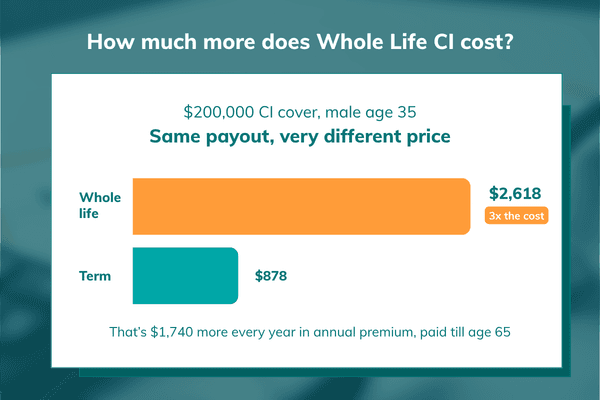
For example, for $200,000 of CI coverage, a 35-year-old man would pay:[3]
That is $1,740 more every year for a Whole life plan, or nearly three times the cost of the term plan, for the same $200,000 payout during your prime working years. The cost will be even higher for older persons. |

A common objection to term insurance is that it ‘wastes money’ because it has no cash value, whereas a Whole Life plan eventually returns your money. The reality?
A portion of your Whole Life premium always goes towards a non-refundable insurance charge anyway. You only get money back because you paid the insurer extra to invest for you.
Unfortunately, these returns are modest. High distribution commissions, admin fees, and the sharing of fund returns with shareholders, mean it can take up to 20 years just to break even on a Whole Life plan.
Thereafter, your actual returns are often in the low single digits, even if the par fund itself reaches the 4.25% per annum illustrated return.[4]
Similarly, some may advocate buying Whole Life CI plans to fund alternative medical treatments in old age when the risk of illness is higher. However, this strategy is highly inefficient. Besides high premiums, it is also impossible to accurately estimate how much alternative treatments will cost decades from now due to inflation.
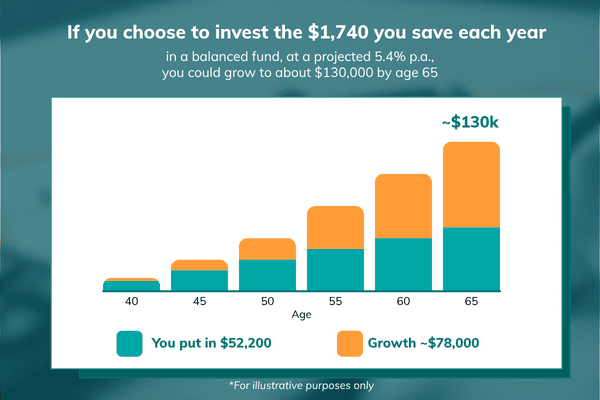
Instead of holding out for a potential CI payout to justify decades of high premiums, a better strategy is to buy a cheaper term plan and grow the premium savings yourself. For example, if choosing term insurance saves you $1,740 a year, that money, if invested in a balanced fund (at a projected 5.4% p.a.) over 30 years, could grow to about $130,000 by age 65.[5] By retirement, you will have a liquid pool of wealth that you can use for anything, including alternative treatments if you need them, or simply funding your retirement if you remain healthy.
Ultimately, MoneyOwl’s philosophy is not just “buy term and invest the rest”. We advocate buying term insurance because it is the only way most people can afford the coverage to fully protect their families. How you use your premium savings, whether investing, topping up CPF, or keeping them in cash, is a separate decision that depends on your needs and your ability and willingness to take risk. Liquid wealth always offers better value and flexibility than being locked into an expensive policy.

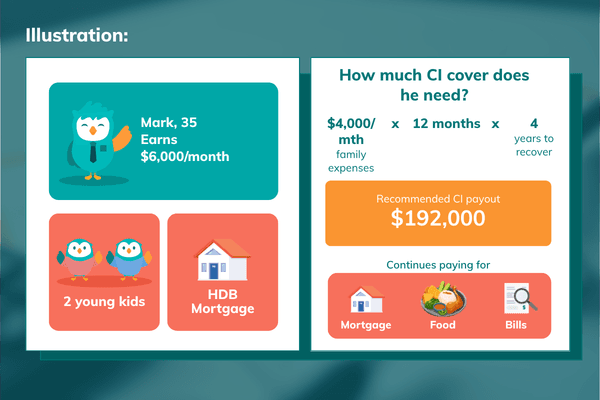
The payout should cover your family’s living expenses and debt obligations for the estimated time it takes to recover (if you do not pass away from the illness), which is typically four to five years. The MAS suggests a baseline benchmark of 4x your annual income in its Basic Financial Planning Guide.
For example: Mark, a 35-year-old earning $6,000 a month. He has two young kids and an HDB mortgage. His contribution towards his family’s core expenses (food, bills, loan repayments) is $4,000 a month. A recommended 4-year CI payout for Mark would be around $192,000 ($4,000 x 12 months x 4 years). If a severe illness forces him to stop working, this lump sum ensures that he can continue his housing loan payments and that his family’s life and finances are not disrupted while he recovers. |

The most affordable and efficient way for Singaporeans to secure CI coverage is to buy a standard term life policy and add a CI "rider" (an add-on) to it. This is because in our market, standalone CI plans tend to be much more expensive and only of the multi-pay genre, or limited to certain sub-classes of CI like cancer.
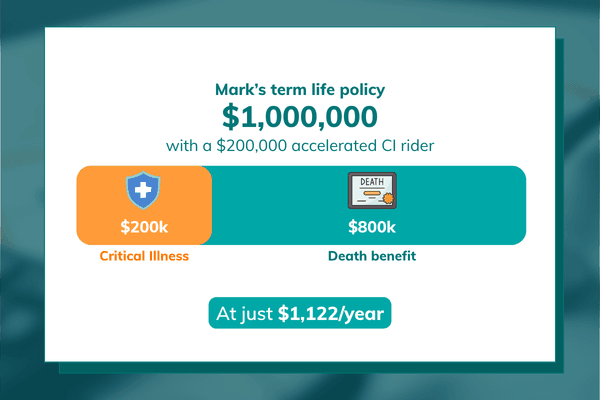
This structure is known as an Accelerated CI payout. "Accelerated" simply means that your CI payout shares the same pool of money as your death benefit, and any CI payout reduces the subsequent death claim.
How a term life policy with an accelerated CI rider works for Mark? Based on his family’s needs, Mark used MoneyOwl’s free Insurance Needs Analyser to calculate his personalised life coverage needs, which turned out to be $1,000,000.[6]
At just $1,122 a year[7], this premium easily fits into Mark’s budget, giving him complete peace of mind against two of life’s most financially catastrophic events. |

Early-stage and multi-pay CI plans are heavily marketed in Singapore, but they are significantly more expensive. So what do you get for the higher premium?
Early-stage CI: Instead of paying out only when an illness becomes severe, early-stage CI pays out when a critical illness is diagnosed at an earlier stage, such as an early-stage cancer.
Multi-pay CI: A standard CI plan pays out once and then ends. Multi-pay CI lets you claim more than once, whether it is a relapse of the same condition or a new critical illness diagnosed later.
Here is how the premiums compare for Mark, with the same $1,000,000 life coverage and $200,000 CI coverage till age 65:[8]
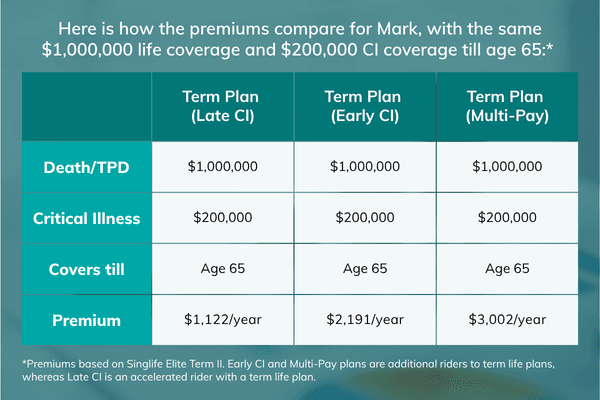
While the coverage is nice to have, early-stage illnesses (like early-stage cancers) rarely force you to stop working for a prolonged period of time. Many employers also offer hospitalisation leave that can be used for treatment.
Therefore, early-stage and multi-pay plans should only be considered if you have the extra budget for them– after you have secured your core late-stage term coverage, and implemented a regular saving/ investing plan for retirement. You should never sacrifice your essential late-stage coverage just to afford an expensive, smaller early-stage policy.

When it comes to CI insurance, waiting is your biggest enemy. You must buy it early, when your health is pristine.
If you wait until you develop "minor" health issues, such as being overweight, high cholesterol, elevated blood pressure, or a manageable chronic condition, insurers may do one of three things:
- Exclude you: They will grant coverage, but refuse to cover you for specific conditions (e.g., "We will not cover any heart-related illnesses").
- Load your premiums: They will charge you a significantly higher monthly premium for the exact same coverage.
- Reject you entirely: They may decline your application altogether.
Lock in this essential coverage and your low premiums when you are healthy, so that no matter what tomorrow brings, your financial resilience is guaranteed. An important tip: do go for your recommended health screenings – but buy your insurance before you do so.

When it comes to affordable term plans, here are two that are arguably the best open secrets in Singapore. Note that MoneyOwl is not paid or incentivised by these insurance providers to write about these solutions.
1) MINDEF & MHA Group Voluntary Scheme. The Voluntary Scheme offers life coverage up to $1 million for just $300 a year (until age 65). Because it is available to a large portion of Singaporeans, including NSFs, NSmen and their spouses and children, it serves as an affordable and easy entry point to securing essential term insurance.
MINDEF & MHA Group Voluntary Scheme[9] premiums for term life and CI:
This works out to just $43 per month |
The key disadvantage of the MINDEF & MHA Group Voluntary Scheme is that the CI rider premiums increase as you move into higher age bands.
2) Direct Purchase Insurance (DPI). All major insurers are required by MAS to provide direct purchase insurance – simple insurance products with standardised terms that are sold without advice, i.e., they are cheaper as they do not include distribution costs like commissions. You can buy up to $400,000 sum assured for both term life insurance and a CI rider. For fixed-term DPI plans, premiums are level, i.e., they do not increase with age. Most major insurers offer online applications for such DPI. Insurers that offer online applications for DPI include Income Insurance, Great Eastern and Etiqa.
| Should Mark decide to buy a DPI Term Life product with a critical illness benefit and a sum assured of $400,000 that covers him until age 65, the annual premium for Etiqa’s Term Life II is $1,012. |
If you have gaps in your CI and/or life coverage, the best move is to act today.
Procrastinating only risks your future insurability and increases your premiums as you age. By choosing a low-cost, fit-for-purpose term insurance, you get the biggest bang for your buck. Plus, because there are no surrender penalties, you retain the complete flexibility to adjust or consolidate your policies in the future without being penalised.

Take these steps today:
1. Use our free Insurance Needs Analyser to work out your life and CI coverage in terms of the sums assured needed. Or you can use the rule of thumb in MAS’ Basic Financial Planning Guide: 9x your annual income for life coverage, and 4x for CI.
2. Consider whether you are eligible for the MINDEF & MHA Group Voluntary Scheme.
3. For DPI, you can visit Comparefirst.sg, an MAS website to compare DPI products.
If you prefer to have a human adviser or explore other types of personal insurance, you may wish to consider our referral partner for insurance, iFAST Financial Pte Ltd. Please refer to the terms and conditions on our referral page.
Disclaimer: Whilst we have taken all reasonable care to ensure that the information contained in this article, including any reference to specific products or services, is not untrue or misleading at the time of publication, we cannot guarantee its accuracy or completeness. You should not act on it without first independently verifying its contents. Any opinion or estimate contained in this article is subject to change without notice. Where individuals are referred to third-party providers, MoneyOwl may receive referral fees in connection with such introductions. Any reference to a product or service should not be construed as financial advice, a recommendation, or an endorsement. Individuals should independently assess the suitability of any product or service before making a decision. Buying insurance is a long-term commitment and should be bought according to your needs, and products’ suitability. The information contained herein does not have any regard to the specific financial objective(s), financial situation or the particular needs of any person. It is advisable to seek advice from a qualified financial adviser to assess your needs and understand the features, risks, and costs of any financial product before making a decision.
This publication has not been reviewed by the Monetary Authority of Singapore