What the SPIVA 2025 Scorecard Tells Us: The Case for Low-Cost, Globally Diversified Investing
10 JUN 2026
By: Li Huijing
Head of Partnerships & Investment Management, MoneyOwl
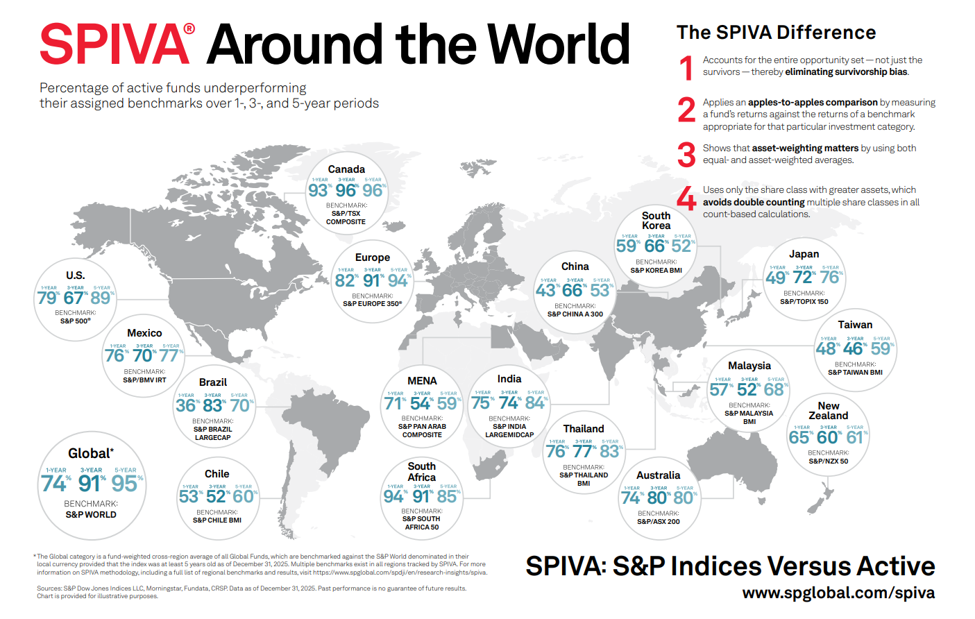
S&P Dow Jones Indices recently released its S&P Indices Versus Active (SPIVA) Scorecard for Year-End 2025.
Widely regarded as a key scorecard in the active versus passive investing debate, the report measures how actively managed funds perform against their benchmark indices.
The latest findings were consistent with results in past years.
Across most developed markets, more than 3/4 of active equity managers underperformed their benchmark over longer time horizons.
While underperformance rates in emerging markets were generally lower, more than half of the active managers still failed to beat their benchmarks.
Interestingly, 2025 was a year in which stock and sector performance diverged significantly.
In theory, such an environment should create more opportunities for skilled active managers to add value through stock selection. Yet despite these favourable conditions, most active managers still underperformed their benchmarks.
The report also highlights another challenge for investors. Even when a manager outperforms in a given year, that success is often difficult to sustain.
SPIVA's persistence studies have consistently shown that relatively few top-performing managers remain top performers over subsequent periods.
There is another risk worth keeping in mind here.
Investors who do pursue passive strategies sometimes concentrate their holdings in a single country index.
Whilst low-cost index investing has clear merits, putting all your eggs in one country's basket introduces concentration risk. A single market can experience volatility and underperform for extended periods due to valuation cycles, currency movements, regulatory shifts, or geopolitical developments.
Spreading exposure across global markets helps smooth out these country-specific risks over time.
Taken together, these findings reinforce the case for staying invested in a low-cost, globally diversified portfolio rather than trying to identify the next outperforming manager - whether in direct investments into unit trusts or in Investment-Linked policies (ILPs).
While individual managers may outperform from time to time, the evidence suggests that long-term investment outcomes are more likely to be driven by cost control, diversification, disciplined investing and remaining invested through market cycles.
If you would like to learn more about how to build a low-cost, globally diversified investment portfolio, visit OwlInvest. You can learn more about the funds used in OwlInvest and how a globally diversified portfolio may be constructed based on your needs and risk profile.
Disclaimer:
While every reasonable care is taken to ensure the accuracy of information provided, no responsibility can be accepted for any loss or inconvenience caused by any error or omission. The information and opinions expressed herein are made in good faith and are based on sources believed to be reliable but no representation or warranty, express or implied, is made as to their accuracy, completeness or correctness. All investments carry risk. Expressions of opinions or estimates should neither be relied upon nor used in any way as indication of the future performance of any financial products, as prices of assets and currencies may go down as well as up and past performance should not be taken as indication of future performance. The author and publisher shall have no liability for any loss or expense whatsoever relating to investment decisions made by the reader.
This publication has not been reviewed by the Monetary Authority of Singapore