By Daphne Lye
Senior Lead, Solutions, Research & Investment, MoneyOwl
In our previous article, we busted common retirement planning myths and explained the concept of decumulation, which is the drawing down of your assets to fund your retirement and prioritising your own needs. We were reminded of the need to take action rather than relying on working contributions to CPF alone, and introduced an easy-to-use, free tool that helps you map out a retirement income plan across your different assets.
With that foundation in place, a natural question follows. If a successful retirement is about building a system that pays you a reliable monthly income for as long as you live, you may be wondering: “How do I build a good, resilient retirement income plan?”
CPF forms the foundation, but is seldom the whole house
CPF should be viewed as the bedrock of retirement planning for Singaporeans. As we work and contribute to our CPF, it compounds and grows at high risk-free rates and pays a stable stream of lifelong income through CPF LIFE. A lifelong annuity is the best hedge for longevity risk, and CPF LIFE is widely known as the best annuity available in the market.
However, as we described in Part I, CPF is fundamentally designed to cover only basic needs, aimed at the lower-middle segment’s needs. Because of salary ceilings and annual contribution limits, there is a cap on the maximum CPF LIFE payout you can receive.
To receive a higher level of retirement income, we will need to draw from our other assets. Most Singaporeans have some cash in the bank and some form of investments or insurance plans on top of their CPF savings, and figuring out how they all work together can feel like a puzzle.
This is where MoneyOwl’s retirement income builder comes in. The tool projects your retirement income from age 65 by combining your CPF LIFE payouts with a smart drawdown of your investments, cash, and CPF OA savings.
To keep the projections realistic, the tool assumes your desired retirement expenses will increase by 2% every year to account for inflation. To fund this growing need, retirement income builder applies the following drawdown in layers:
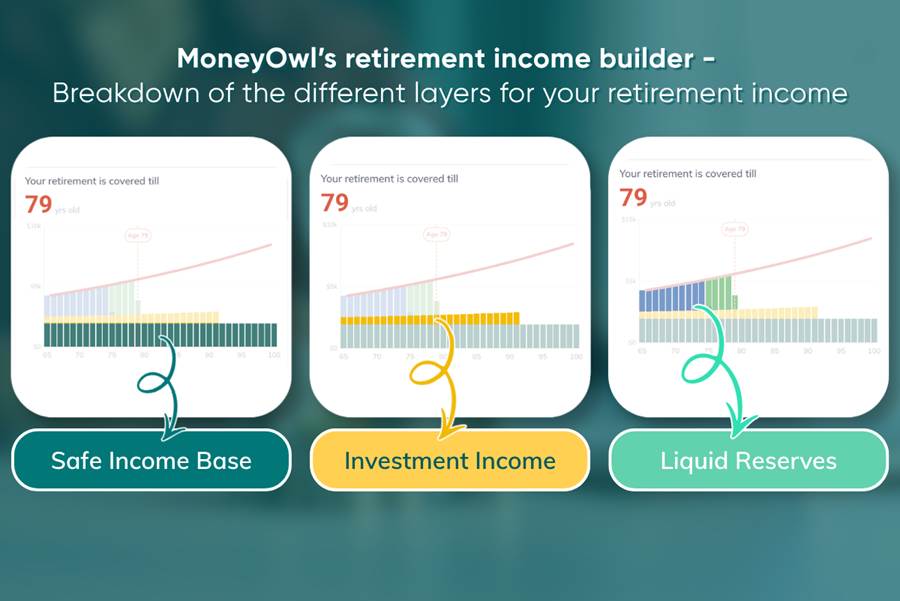
- Safe Income Base: Your CPF LIFE payouts form your foundational income.
- Investment Income: To fill the gap between your CPF LIFE payouts and rising expenses, the tool assumes a decumulation from your investments, which are assumed to be in a balanced 60/40 portfolio. In line with the “4% withdrawal” rule-of-thumb, it uses a 4% initial withdrawal rate, increasing by 2% annually to combat inflation.
- Liquid Reserves: If the combination of CPF LIFE and regular income from investment withdrawal is still insufficient for your needs (the red line), the tool taps into your cash savings (in light blue), followed by your CPF OA (in light green). Cash savings are drawn first as your CPF OA savings earn a higher 2.5% p.a. interest rate, but also can be withdrawn from age 55. Ultimately, the model provides a clear timeline, showing how long your wealth will last, up to age 100.
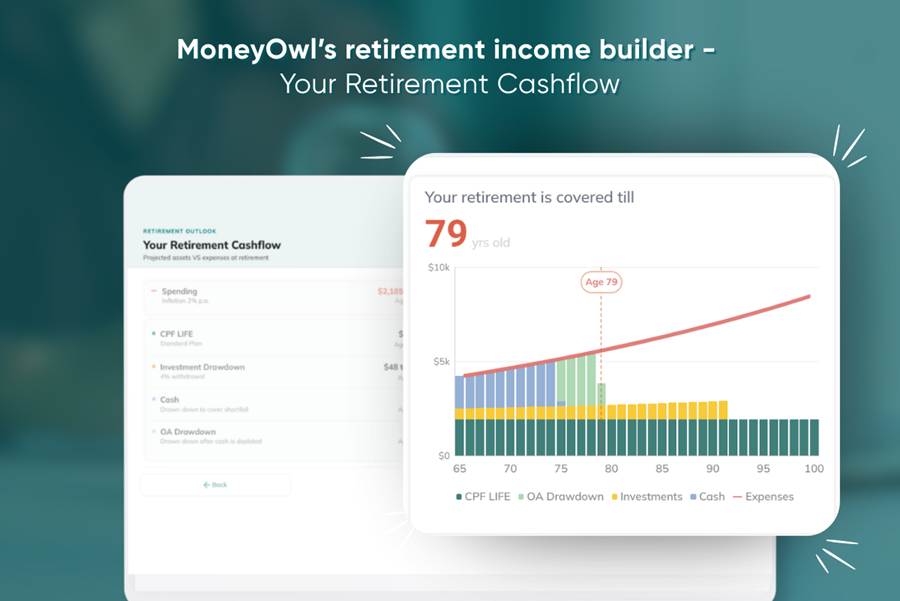
Your personalised retirement income plan is then assessed along the SSF framework developed by MoneyOwl: Sufficiency, Safety, and Flexibility.
The SSF Framework to Retirement Income Planning
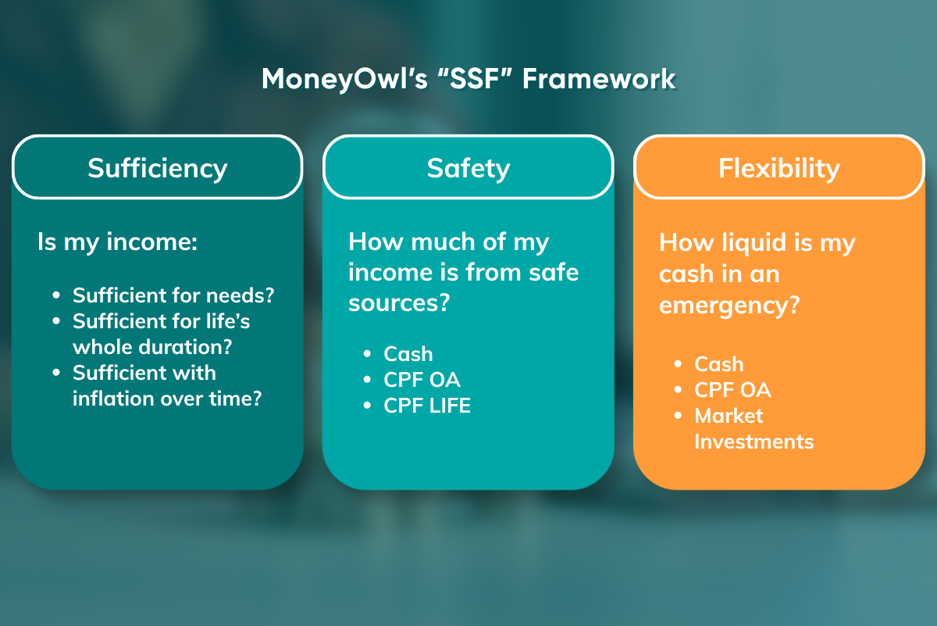
1. Sufficiency: Will your money last for as long as you live (and keep up with inflation)?
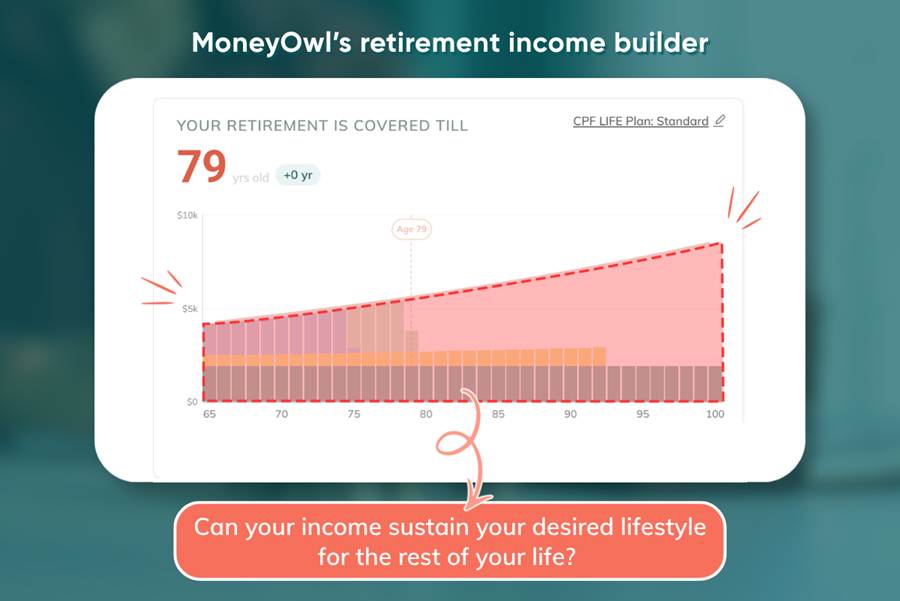
The first test is simple: Can your income sustain your desired lifestyle for the rest of your life? It is how much the “area under the red line” is covered.
Singaporeans are living longer than ever, which means your retirement could easily stretch for 25 to 30 years. In 2025, the average life expectancy of a 65 year old is 86.6 years, which increased from 85.8 years in 2015. This means that 1 in 2 65 year olds will live beyond 86.6 years.
And if you are below age 65, your average life expectancy when you reach 65 will probably be longer.
This means that when you retire, your financial plan needs to comfortably carry you to age 90 and preferably beyond because we do not know how long we will live.
Sufficiency also means accounting for the long-term impact of inflation.
If your income remains flat over a 20- to 30-year retirement, the escalating costs of essentials and healthcare will eventually erode your standard of living. This is represented by the red line sloping upwards.
To ensure your portfolio remains sufficient, your retirement income must grow and keep pace with these rising costs over time. Here is where investment withdrawal does well.
Alternatively, you can build a thicker first layer of CPF LIFE.
2. Safety: How stable are your income sources?
Just as you rely on a steady income while working, you’ll want the same stability in retirement. If an economic downturn suddenly cuts off or drastically reduces your dividend or rental income, the resulting stress can be overwhelming.
That is the core of the Safety pillar: securing a guaranteed, lifelong income floor that you can count on, unaffected by market ups and downs.
For Singaporeans, our safety net is CPF LIFE. It provides a risk-free, lifelong monthly payout that forms the bedrock of your retirement.
While investments may provide the Sufficiency to beat inflation, your CPF LIFE (and other safe instruments like Singapore Savings Bonds or private annuities) provides the Safety to ensure your basic needs can always be met, giving you peace of mind. CPF LIFE can form your “Safe Retirement Income Floor” – to meet your “die-die-must-have” income.
In contrast, investments represent the opposite of Safety.
Because investments carry market risk and fluctuate constantly, you should not rely on them to fund your most essential expenses. Instead, treat your investment returns as a flexible budget for discretionary spending.
Use them for holidays or dining out, things you can easily scale back during a market downturn without disrupting your daily retirement life.
3. Flexibility: Do you have cash on hand for emergencies?
Life is unpredictable. Even in retirement, you may encounter large, unexpected expenses such as major home repairs or out-of-pocket medical bills.
Flexibility is about access to liquid cash in a lump sum when you need it. You may live in a fully paid million-dollar property and receive a sufficient CPF LIFE payout every month, but you can’t easily convert either of those into $50,000 cash for an emergency.
To stay flexible, keep a portion of your wealth in cash or easily accessible investments. This ensures you can handle big, unexpected expenses without having to sell your house or disrupt your regular income.
The Balancing Act
Unless one is very wealthy, it is difficult to score high on all three aspects.
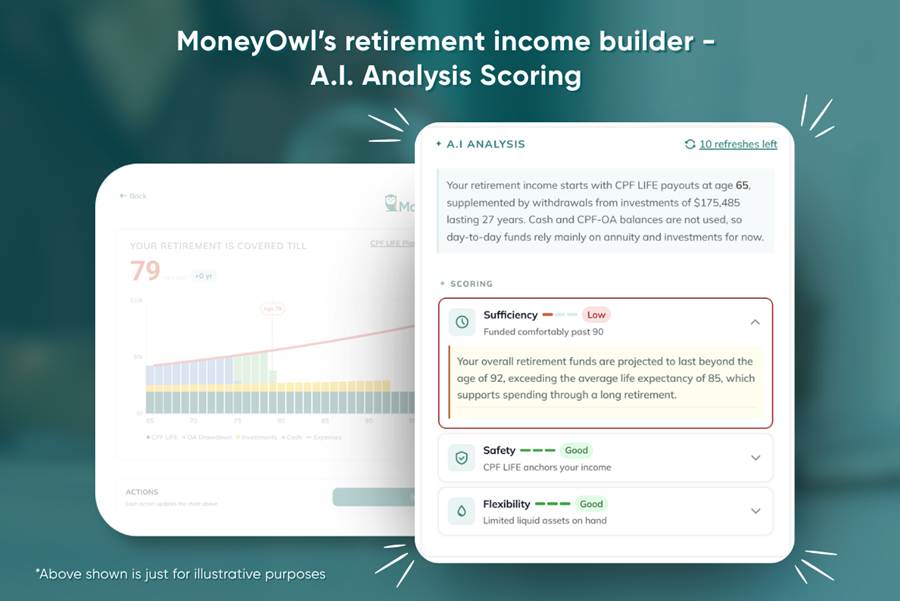
- CPF LIFE gives you high Safety, but low Flexibility as you can’t withdraw a lump sum from it.
- Cash in the bank and safe instruments such as Singapore Savings Bonds and T-bills provide high Flexibility but low Sufficiency because they lose value over time due to inflation.
- Investments (including in property) may provide you with Sufficiency to grow your wealth but are subject to market risk, credit risk, sequence of returns risk, etc.
- Insurance products vary on the scoring depending on the type of product. Traditional retirement income plans provide a strong level of Safety through guaranteed payouts. Conversely, Investment-Linked Policies (ILPs) score low on Safety as their returns depend entirely on underlying investments that carry market risk. Furthermore, due to built-in costs, most insurance products are low on Sufficiency unless a substantial amount of capital is committed upfront. Finally, Flexibility is highly variable, depending on the specific product’s design and withdrawal rules.
MoneyOwl’s Recommended Approach
To gauge your retirement resilience, the retirement income builder assesses your projected income across the three dimensions of Sufficiency, Safety, and Flexibility, assigning a 1- to 3-star rating for each.
Firstly, the Sufficiency score measures whether your income fully meets your retirement expenses, and for how long. We anchor the milestones to the latest life expectancy data. For a 65-year-old in 2025, the average life expectancy is about 87 years (86.6 to be exact). In fact, over 60% are expected to live to age 85, and nearly 40% will celebrate their 90th birthday.
Using this data, Sufficiency is scored as follows:
- 1 Star (Shortfall before 85): Funds run out before average life expectancy.
- 2 Stars (Shortfall at 85–90): Funds cover the majority of expected retirement years.
- 3 Stars (No shortfall before 90): Funds cover well beyond average life expectancy.
Next, the Safety score evaluates the stability of your retirement cash flow. It calculates the proportion of your total income drawn from low-risk sources, such as CPF LIFE payouts, cash reserves, and CPF OA balances. A higher score indicates that your retirement lifestyle is well-protected against market risks.
Safety is scored as follows:
- 1 Star (< 50%): Less than half of your total income is covered by stable sources.
- 2 Stars (50–74%): The majority of your total income is covered by stable sources.
- 3 Stars (≥ 75%): A large majority of your total income is covered by stable sources.
Finally, Flexibility measures your access to liquid assets at the start of your retirement (age 65). It calculates the percentage of your total wealth that can be quickly withdrawn as a lump sum. To reflect market liquidity risk, the value of your investments is discounted by 30% in this calculation.
Flexibility is scored as follows:
- 1 Star (< 30%): Limited liquidity. Less than 30% of your assets are easily accessible for unforeseen expenses.
- 2 Stars (30–49%): Moderate liquidity. A healthy proportion of your assets is available to act as an emergency buffer.
- 3 Stars (≥ 50%): High liquidity. Half or more of your total assets can be accessed as a lump sum if needed.
For a well-balanced plan, we recommend adjusting your retirement strategy to achieve a minimum of 2 stars across all three dimensions.
Implementing the SSF Framework for Retirement Planning
To build a resilient retirement plan, MoneyOwl recommends a two-tiered approach:
First Tier: Safe Retirement Income Floor (for essential expenses)
Prioritise Safety for your essential expenses by using guaranteed income instruments, such as CPF LIFE payouts. This is your Safe Retirement Income Floor.
It is best for you to do a budgeting exercise to estimate your expenses in retirement. However, if you do not know what this might be in retirement, we recommend aiming for the CPF Full Retirement Sum (FRS) in cash as a minimum. In 2023, basic monthly living expenses for a single senior were $1,384. Adjusted for 2% annual inflation, this is about $1,790 by 2036 which is close to the 2026 FRS payout (which starts from 2036).
Tier 2: Lifestyle Buffer (for discretionary spending)
Once your basic needs are met, invest for Sufficiency with Flexibility to fund discretionary expenses like holidays.
How you manage this second bucket depends on your preferred investment strategy:
- [MoneyOwl’s default strategy in the retirement income builder] If you use a withdrawal strategy such as the 4% rule, choose a globally diversified portfolio that provides a high probability of sufficient returns during retirement.
As you will be drawing down from this portfolio, a moderate risk level, such as a 60/40 portfolio (comprising 60% equities and 40% bonds) is recommended, provided it aligns with your risk appetite. If you had been in a high-risk or aggressive portfolio before retirement, start de-risking your nest egg about five years before you retire to lock in your gains, and gradually shifting to a more conservative risk level.
Tip: Be prepared to withdraw less during market downturns, which protects your portfolio from depleting too quickly when the market drops (known as sequence-of-returns risk).
- If you prefer an income strategy comprising bonds, dividend stocks or income funds, or a retirement income insurance product, protect yourself from default and concentration risks by choosing a professionally managed, broadly diversified portfolio.
Regardless of your strategy, always keep costs low. High fees, fund expense ratios, and hidden product commissions will eat directly into your retirement income.
Besides your safe income floor and investment portfolio, you also need to maintain some degree of Flexibility in your retirement plan. Keep a portion of your wealth in liquid assets to handle unforeseen expenses. The CPF OA is an ideal vehicle for this cash buffer, offering high safety and a guaranteed 2.5% p.a. return. If you used your CPF OA savings for your property purchase, you can make a voluntary housing refund to your CPF OA.
As you set up these income buckets and cash buffer, remember to prioritise your retirement income needs above leaving a legacy. You should also avoid locking your money into inflexible high-cost structures or products so you have the flexibility to adjust your retirement plan as your needs change over time.
Conclusion
It is never too early to plan for retirement. The decisions you make along the way about how you balance spending on housing, investing and insurance can have a long-lasting impact.
In Singapore, retirement planning begins with CPF. It is a powerful, risk-free foundation, and maximising it early allows you to harness the magic of compound interest.
But even with a late start, the most crucial action is to begin. Given today’s longer life expectancies, your planning and investment horizon is likely longer than you realise.
Ultimately, a good retirement income plan is one that balances Sufficiency, Safety and Flexibility. By building buffers and reviewing your plan regularly, you can enter retirement with confidence and peace of mind.
Disclaimer
While every reasonable care is taken to ensure the accuracy of information provided, no responsibility can be accepted for any loss or inconvenience caused by any error or omission. The information and opinions expressed herein are made in good faith and are based on sources believed to be reliable but no representation or warranty, express or implied, is made as to their accuracy, completeness or correctness. MoneyOwl shall not be liable for any loss or expense whatsoever relating to investment decisions made by the reader. This article has not been reviewed by the Monetary Authority of Singapore.